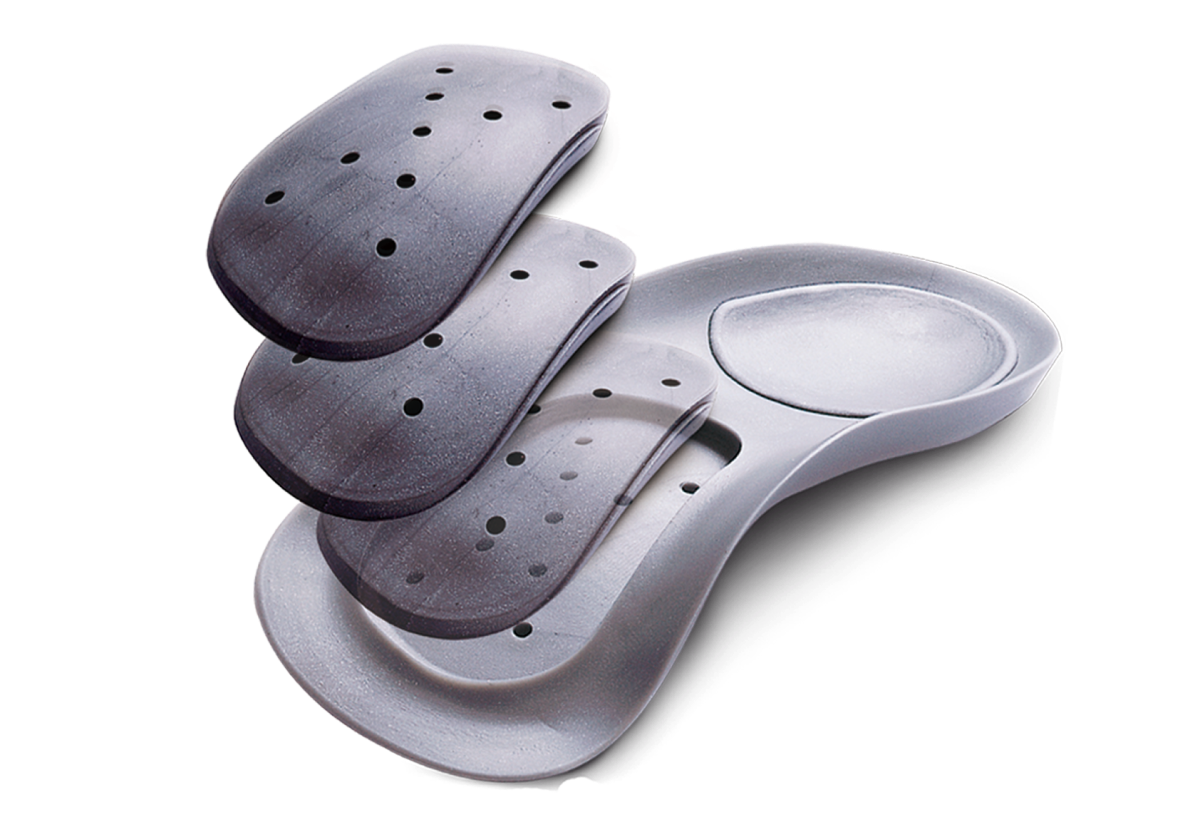
What is an insole?
In English, a shoe sole is called an "insole." In this context, "sole" refers to the "bottom of the foot" or "bottom," and the dictionary definition of a shoe sole is an object placed on the inner bottom of a shoe. It typically refers to a soft insole placed on top of the shoe's inner sole to alleviate its high hardness.
What are functional insoles?
Functional insoles are insoles manufactured to perform specific functions by intentionally applying physical modifications to the material and shape of standard insoles. They can be purchased in general markets. Commercial insoles focus on providing temporary comfort while wearing shoes. Therefore, most functional insoles primarily use low-hardness materials that provide a thick and soft cushioning effect (high elasticity).
What are functional foot orthotics (orthotics)?
Functional foot orthotics are generally made with higher hardness (lower elasticity) compared to functional insoles. Therefore, you may experience an awkward sensation, such as a slight foreign body feeling, during the initial period of wear; however, this serves as the first step toward achieving the goal of foot correction (arch normalization). In contrast to functional insoles, which focus on momentary convenience, the purpose of functional orthotics is to normalize the foot's arch to provide permanent stability.
Foot orthotics (orthotics) differ from general functional insoles in that, since they are intended for treatment and correction, they require a doctor's prescription to diagnose the user's foot and determine the appropriate orthotic device.
What is a foot arch?
An arch refers to a broad curved shape, and the arch of the foot refers to the part of the sole that curves inward like a bow. If this arch is flat beyond a certain level, it is called a flat foot, and if it is excessively curved, it is called a high arch. In other words, everyone has a different arch, and even among people with the same flat foot (high arch), the size of the arch varies.
Foot size and arch size are completely different.
Most functional insoles standardize arch sizes and focus on foot size. However, foot size and arch size are completely different concepts. Since the position, height, and area of the arch vary from person to person, when selecting a foot orthotic (corrective device), you must wear one that best fits your specific arch condition. This is precisely why, as mentioned earlier, a doctor's diagnosis and prescription are required.
Transverse arch and longitudinal arch
When prescribing foot orthotics, the required arch size is broadly divided into the transverse arch (horizontal width) and the longitudinal arch (vertical length). Since flat feet have low arches and high arches have high arches, the height must also be measured precisely. Wearing functional or standard insoles that are unsuitable for one's arch size and height can lead to musculoskeletal abnormalities beyond mere momentary discomfort. This is due to the principles of biomechanics and the kinetic chain. Conversely, the most suitable orthotic serves as the starting point for body balance and alignment.
Kinetic Chain
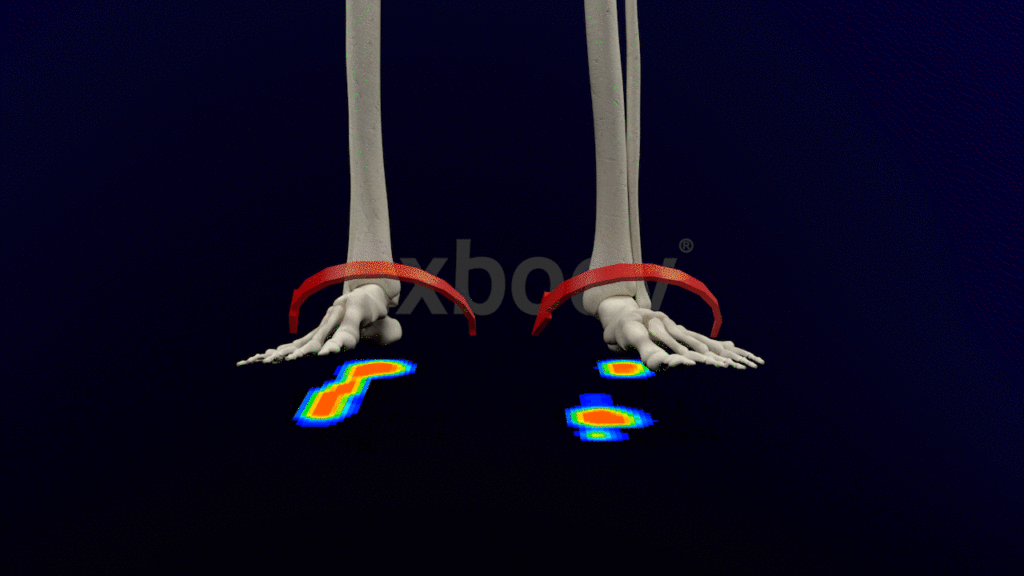
You have likely experienced your entire body exhibiting a tendency to rotate when you grab someone's finger and twist it in one direction. Similarly, when you abruptly twist one foot to avoid an obstacle on the floor, your entire body twists or tilts in the same direction. This phenomenon, where the entire body follows the direction of movement of specific parts such as bones and joints, is called the kinetic chain.
Principles and Key Effects of Functional Foot Orthotics (Corrections)
Due to the principles of this kinetic chain, changes in the foot can affect the knees, hips, pelvis, lower back, torso, and even the cervical spine; therefore, extreme caution is required when selecting insoles or functional orthotics. It is neither an exaggeration nor a falsehood to claim that functional foot orthotics can be a partial solution to pain in the entire musculoskeletal system. However, the extent of their assistance simply varies depending on the severity of the user's (patient's) condition.
In fact, some dental clinics recommend wearing foot orthodontics in addition to straightening the teeth for the purpose of orthodontic treatment. This is because they have concluded that the condition of the feet can also affect the oral structure.
Of course, the primary effect of foot orthotics (corrective devices) manifests in the feet. It is common practice in hospitals to prescribe foot orthotics for foot conditions such as hallux valgus and plantar fasciitis.
In the next content, I will share some interesting stories about the types of functional foot orthotics.
View HeyPose foot orthotics in detail: Check HeyPose Insoles (Click)